
Identify what the session number includes
Read the output label and its method note before using the number. A label such as “active,” “exercise,” or “total” needs a definition from the tool that produced it. Do not assume every app uses the same terms. A total for a workout is also different from total energy for an entire day. Record the start and end times, or the session duration, beside the value. Two numbers cannot describe the same period if one includes a warm-up and the other begins after it.
This guide uses “net” to mean exercise energy above rest. It does not mean food energy minus exercise energy, a daily energy balance, or a recommended intake. Keep these questions separate when reading a diary or app. If a tool does not explain its label, you cannot reliably convert its number just by changing the word. The conversion needs a gross value and the resting baseline used for the same session.
Subtract rest for the same duration
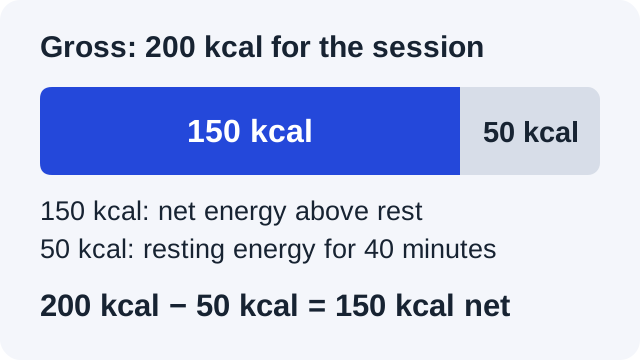
Start with gross session energy in kilocalories (kcal), the duration in minutes, and the resting rate used by that method. Keep a measured rate separate from a predicted rate. Retain that baseline with the answer and label the result as net energy above rest.
Assume a hypothetical gross session energy of 200 kcal over 40 minutes and a matching resting estimate of 1,800 kcal per day. These invented inputs illustrate arithmetic; they do not describe a measured person or a suggested exercise session.
- Convert the day to minutes: 24 × 60 = 1,440 minutes.
- Find the resting rate: 1,800 kcal/day ÷ 1,440 min/day = 1.25 kcal/min.
- Find rest for the session: 1.25 kcal/min × 40 min = 50 kcal.
- Subtract session rest: 200 kcal − 50 kcal = 150 kcal net.
Check the result by reversing the subtraction: 150 kcal net + 50 kcal at rest = 200 kcal gross. The same resting amount must appear in both directions. Subtracting the full 1,800 kcal daily value from a 40-minute session would mix time periods. If your resting value is already in kcal per hour, multiply it by session hours instead. Keep one time unit throughout each multiplication. Round the final display after the calculation, and state whether the original inputs were rounded.
Hypothetical 40-minute session. The resting baseline is an assumed 1,800 kcal/day. These are calculations, not measured energy values.
| Part of the calculation | Energy |
|---|---|
| Gross session energy | 200 kcal |
| Resting component: 1,800 ÷ 1,440 × 40 | 50 kcal |
| Net energy above rest: 200 − 50 | 150 kcal |
| Reverse check: 150 + 50 | 200 kcal |
Keep the resting convention with a MET estimate
Under the approximate kcal convention, gross kcal = MET × body mass in kg × duration in hours. The matching resting component is 1 × kg × hours. Subtracting it gives net kcal = (MET − 1) × kg × hours. With an assumed 4 MET, 75 kg and 40 minutes, duration is 40 ÷ 60 = two-thirds of an hour. Gross is 4 × 75 × two-thirds = 200 kcal. Rest is 1 × 75 × two-thirds = 50 kcal. Net is 3 × 75 × two-thirds = 150 kcal. The assumed 4 MET is an example, not a value assigned here to a particular activity.
This example happens to match the earlier 1,800 kcal/day baseline because 75 kcal/hour × 24 hours = 1,800 kcal/day. That match is arithmetic, not a rule for every person. An oxygen-based estimate that uses 3.5 mL/kg/min and an assumed kcal per litre can give a different result from the approximate 1 kcal/kg/hour convention. State which conversion you used. Do not mix one method’s gross value with another method’s resting component and describe the answer as a matched net estimate.
Read Body Numeral’s calculator as its own model
Body Numeral’s calories burned calculator shows estimated session energy that includes rest. It predicts resting energy with the Mifflin–St Jeor equation, divides that daily estimate by 1,440, and multiplies the rate by its activity value and session minutes. It displays the resting estimate and activity value with the result. This is the site’s stated calculation. It differs from simply multiplying a standard Compendium MET by body mass and hours. A shared activity label does not make the two outputs equivalent.
To express that calculator result above its own resting baseline, subtract displayed resting kcal/day ÷ 1,440 × session minutes from its gross session estimate. Use the same session and inputs. Display rounding can cause a small difference from calculation with full internal values. Record this as an estimate derived from the calculator, not a new physiological measurement. The calculator’s weekly energy row repeats its gross session model across the selected frequency. It is not a separate total-daily-energy measurement.
Compare two results without counting the same energy twice
For each result, record the tool and method, date, session duration, activity, unit, gross or above-rest definition, and any known resting baseline. Match the period and unit, then the definitions. Two hypothetical values of 200 kcal gross and 150 kcal net agree when the resting component is 50 kcal. If a gap remains, compare the activity assumptions and prediction methods. Averaging different estimates does not produce a measurement.
A total daily energy expenditure estimate already includes resting energy and activity under its selected assumptions. Subtracting session rest solves one accounting difference; it does not prove that the activity itself is absent from an existing daily estimate. Check the daily method before adding a separate exercise number. The activity-assumption guide explains the whole-day question. This session procedure provides no personal calorie allowance, intake target, weight-loss forecast, or judgment about which result is right for you.
If your subtraction produces a negative value, recheck the label, duration, unit and baseline before interpreting it. A mismatch between estimates can produce a misleading answer. Preserve the original number and its method note in your record. For arithmetic comparisons, keep gross and net values as separate labeled entries; for a health decision, a calculator result alone does not supply the needed assessment.
Common questions
Does net exercise energy mean calories eaten minus calories burned?
Not in this guide. Here it means session energy minus the resting component for the same duration. An app may use net calories for a different calculation; read its definition.
Is the Body Numeral session result gross or net?
It includes resting expenditure during the activity. To calculate energy above its own resting estimate, subtract that estimate for the same session time. The result remains a model estimate.
Can I subtract a whole day of resting energy from a workout?
No. Use only the resting energy for the workout’s duration. Convert the daily or hourly rate to that same time period before subtracting.
CHECK THE EVIDENCESources & limitations4 sources
Sources checked October 12, 2026. These notes explain methods and assumptions. They have not received an independent clinical review.
- E-MECHANIC secondary analysis methods subtract matching resting components from measured and estimated gross exercise expenditure to obtain net expenditure. (opens in a new tab)pmc.ncbi.nlm.nih.gov
- The 2024 Adult Compendium describes standardized MET values, the approximate kcal convention, and its adult population scope. (opens in a new tab)pmc.ncbi.nlm.nih.gov
- The Compendium distinguishes standard and corrected MET approaches and states that neither replaces direct measurement or removes all error. (opens in a new tab)pacompendium.com
- Original Mifflin–St Jeor research provides a resting energy prediction equation; it does not validate the site’s custom session scaling. (opens in a new tab)pubmed.ncbi.nlm.nih.gov


