
Read the unit before the number
Start with a result whose unit and method are stated. Copy its original label, value, unit, test date and body mass. If the report says VO₂ peak, keep that label. If it says estimated VO₂ max, keep “estimated” beside the converted value.
Do not compare 3.0 L/min directly with 40.0 mL/kg/min: the numbers use different scales. Both can describe the same hypothetical result at a body mass of 75 kg. If the report gives only a number, ask its provider for the unit before calculating.
Convert L/min to mL/kg/min
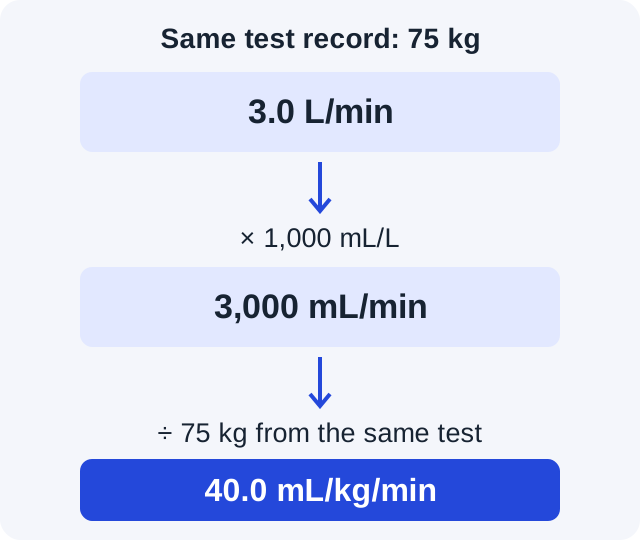
- Record the oxygen-uptake rate in L/min and the body mass in kg from the same test.
- Multiply L/min by 1,000 mL/L to obtain mL/min.
- Divide mL/min by body mass in kg. The result is mL/kg/min.
- Keep the full result during the calculation. Round the final display and label the rounding.
For a hypothetical result of 3.0 L/min at 75 kg, first calculate 3.0 L/min × 1,000 mL/L = 3,000 mL/min. Then calculate 3,000 mL/min ÷ 75 kg = 40.0 mL/kg/min. The litres cancel in the first step. Dividing by kilograms introduces the “per kilogram” part of the second unit. The minute remains in the denominator throughout. You have expressed the same oxygen-uptake rate relative to the recorded body mass; you have not performed a new fitness test.
A common mistake is to divide 3.0 by 75 and stop at 0.04. That answer is in L/kg/min. Multiply it by 1,000 to obtain 40.0 mL/kg/min. Another mistake is to use pounds in the denominator while labeling the result “per kilogram.” Convert pounds to kilograms first, using the measurement-unit guide or measurement converter. Do not use height, body mass index, fat-free mass or a reference weight as a substitute for the body mass required by this calculation.
Convert mL/kg/min to L/min
To reverse the conversion, multiply the mass-relative result by the body mass in kilograms. This cancels the “per kilogram” term and gives millilitres per minute. Divide by 1,000 to express that rate in litres per minute. For the same hypothetical record, 40.0 mL/kg/min × 75 kg = 3,000 mL/min; 3,000 mL/min ÷ 1,000 mL/L = 3.0 L/min. Use the weight associated with the original result, rather than today’s weight if it has changed.
The reverse calculation also provides an arithmetic check. Convert your answer back with the same mass and compare it with the starting value. Small differences can occur if you used a rounded displayed value. For example, a hypothetical 3.2 L/min at 73 kg gives 43.8356… mL/kg/min, displayed here as 43.8 to one decimal place. Converting that rounded display back gives 3.1974 L/min. The small difference comes from rounding. It does not represent a change in the person’s oxygen uptake.
Hypothetical conversions. Relative values are rounded to one decimal place after calculation. These are arithmetic examples, not reference ranges.
| Absolute rate | Body mass from the same record | Mass-relative rate |
|---|---|---|
| 3.0 L/min | 60 kg | 50.0 mL/kg/min |
| 3.0 L/min | 75 kg | 40.0 mL/kg/min |
| 3.2 L/min | 73 kg | 43.8 mL/kg/min |
Keep body mass with each test record
A mass-relative number can change when its denominator changes. Suppose two hypothetical records both show 3.0 L/min. At 75 kg, the rate is 40.0 mL/kg/min. At 70 kg, it is about 42.9 mL/kg/min, rounded to one decimal place. In this example, the absolute rate is unchanged. The higher mass-relative value follows from dividing by a smaller mass. This illustrates the arithmetic only. It is not a weight-loss recommendation or evidence that a real person’s test results would remain unchanged.
For a comparison over time, retain both the absolute and mass-relative values when the report supplies them. Keep each value paired with its own test mass. Recalculating an older value with a newer weight creates a different arithmetic scenario; it does not recover the original test result. A notebook entry can state the date, test method, original value and unit, mass in kg, converted value and rounding. That record lets you identify whether a difference comes from the oxygen rate, body mass or calculation. It cannot establish why a biological change occurred.
Conversion preserves the original method limits
This procedure answers a unit question. It does not assign a fitness category, determine whether exercise is safe or interpret a clinical test for you. For a personal question about a laboratory report, ask the test provider or a qualified health professional. Take the original report with its units and method. For an arithmetic check, use the original oxygen rate and its associated body mass, and keep the unrounded result until the final display.
Common questions
Is mL/min the same as mL/kg/min?
No. A rate in mL/min is absolute. Divide it by body mass in kg to obtain mL/kg/min. Do not multiply by 1,000 when the starting rate is already in millilitres.
Can I use a different weight to convert an old result?
You can calculate a hypothetical scenario, but use the weight from the original test to recover its paired result. Label any calculation that uses a different weight.
Does conversion make a calculator estimate more accurate?
No. Conversion changes the unit while retaining the original estimate and its limits. It does not provide a new measurement or clinical validation.
CHECK THE EVIDENCESources & limitations3 sources
Sources checked October 12, 2026. These notes explain methods and assumptions. They have not received an independent clinical review.
- University of Glasgow teaching exercise: convert L/min to mL/kg/min by multiplying by 1,000 and dividing by body mass in kg. (opens in a new tab)mvls.gla.ac.uk
- SUNY Cortland teaching laboratory describes respiratory gas collection and analysis, and conversion of oxygen uptake to body-mass-relative units. (opens in a new tab)web.cortland.edu
- Uth and colleagues studied a heart-rate ratio prediction in 46 well-trained men aged 21 to 51 and stated that other groups required direct validation. (opens in a new tab)pubmed.ncbi.nlm.nih.gov


